Why ConverSight
Most operations-heavy organizations run on multiple disconnected systems — an ERP for transactions, a BI tool for reporting, a planning tool for forecasting, and standalone inventory or procurement solutions for execution. These systems do not share a common data model, which forces teams to reconcile data across sources, delays the operational window to act, and creates a persistent gap between insight and action.
When planning, intelligence, and execution are distributed across separate systems, decision latency is an architectural certainty — not an operational failure. Data that exists in one system is unavailable to the agent or workflow operating in another. Actions that depend on cross-functional context cannot be initiated until that context is manually assembled. The result is an organization that is always informed after the fact and always responding behind the curve.
ConverSight is the Decision Intelligence Platform that closes that gap. Built with an Agent-First architecture and specialized for supply chain — with native reach into manufacturing, logistics, finance, and marketing — it brings planning, operational intelligence, analytics, coordination, and autonomous execution into a single platform. Every signal, every insight, and every action shares the same operational context and the same governed record of outcomes.
Supply chains are not won by better reporting. They are won by decisions made at the right moment — and executed without delay.
Production-Ready From Day 1 — Not a Proof-of-Concept Framework
The market is full of AI tools that are excellent at building demos. Connect a sample dataset, prompt a model, screenshot the output, ship the slide. The path from that demo to a production workload running against your real ERP, with real users, real compliance requirements, and real consequences for getting it wrong, is where most enterprise AI initiatives stall.
ConverSight is the opposite shape. It is not a framework to build with — it is a platform to run on. The algorithms, the ERP and data-source connectors, the governed semantic layer, the agent runtime, the guardrails, the audit trail, the deployment infrastructure — all of it ships pre-built and production-ready. Connect your data and the platform starts producing decision-grade output on day 1.
| What most AI systems give you | What ConverSight ships with |
|---|---|
| An LLM API + an SDK to wire it up | A configured agent runtime, ready to run workloads |
| Sample notebooks to prototype | Pre-built ERP connectors (SAP, Oracle, Dynamics, NetSuite, Acumatica, SAGE) |
| A vector database to populate yourself | A governed supply chain semantic layer, pre-modeled |
| Examples of how to orchestrate agents | Solution Apps for demand, supply, production, supply assurance, sales order |
| "Production hardening is left to the integrator" | Audit trail, RBAC, guardrails, rollback, SOC 2 / ISO 27001 — built in |
The practical difference: where other paths begin a 6-to-12-month build-out before the first production workload, ConverSight has your first Decision Board live within two weeks and your first agentic workflow running within four. The bring-your-own-everything middleware approach is excellent for research and PoCs. It is not what gets a supply chain team to a measurable outcome in a quarter.
Not BI. Not a chatbot. Not generic agents.
The enterprise AI market is now crowded with claims of "agentic AI." Every BI vendor has added a chat interface. Every LLM provider has packaged a co-pilot. And a new wave of "AI agents" promises to automate everything. The result: genuine differentiation is harder to see — and easier to dismiss.
ConverSight's position is precise. Athena is not BI with a chat layer. It is not a general-purpose AI assistant. It is not an agent framework that requires custom development. It is Decision Intelligence — a category defined by the continuous loop of signal detection, contextual reasoning, governed action, and feedback-driven learning, purpose-built for supply chain operations.
| Capability | Traditional BI | Generic Chatbot | AI Agents (generic) | Athena — Decision Intelligence |
|---|---|---|---|---|
| Understands your data | Dashboards only | Generic context | Partial context | Deep supply chain semantic layer |
| Can reason & plan | No | Conversational only | Limited | Multi-step, multi-system |
| Takes real action | No | No | Prompt-only | ERP, suppliers, schedules |
| Closed-loop learning | No | No | No | Signal to feedback loop |
| Supply chain domain | Generic | Generic | Generic | Purpose-built for SC |
| Deployment speed | Months | Days (chat only) | Weeks-months | Days to weeks, full platform |
| Controlled autonomy | N/A | N/A | Limited | Guardrails, audit, RBAC |
Decision Intelligence is defined not by what Athena knows, but by what it does with that knowledge: it closes the loop from data to decision to action to outcome — continuously and autonomously, within the guardrails your organization defines.
The Decision Intelligence Loop
Where traditional tools stop at detection — showing you there is a problem — Athena completes the full loop. It is not enough to surface a signal. Decision Intelligence connects every signal to an outcome and learns from the result.
| Stage | What Athena Does |
|---|---|
| 1. Signal | Detects a data event — shortage, forecast deviation, overdue PO. |
| 2. Decision | Reasons across context: impact, priority, history, business rules. |
| 3. Action | Executes: contacts supplier, updates ERP, distributes alert. |
| 4. Feedback | Captures the outcome: supplier response, delivery change, KPI movement. |
| 5. Learning | Updates its models — decisions get faster and more accurate every cycle. |
This loop runs continuously across your supply chain. Each completed cycle makes the next decision faster and more accurate. Over time, Athena does not just automate — it compounds intelligence.
What other tools stop at
- A dashboard shows a shortage alert
- An email is sent to a planner
- The planner decides what to do
- The planner contacts the supplier manually
- No outcome is recorded — no learning occurs
What Athena completes
- Shortage detected against coverage threshold
- Impact scored, supplier history checked
- Supplier contacted, ERP updated
- Delivery commitment captured
- Lead-time model updated for that supplier
How Athena Knows Your Data — Without Hallucinating It
The most common concern with enterprise AI is reliability. Can it be trusted to reason over your actual supply chain data — or will it fabricate numbers, invent supplier names, or confidently answer questions it cannot actually answer? This is a fair and important question.
Athena's architecture is designed explicitly to address it. Athena operates on a governed semantic layer of your enterprise data — not raw LLM text generation. Every factual response traces back to a defined data source. When Athena says a part has 4 days of coverage, that number comes from your inventory and demand actuals, not from a language model's inference.
| What Athena is NOT | What Athena IS |
|---|---|
| Raw LLM generation against free text | Governed semantic layer over your enterprise data |
| Probabilistic hallucination over unstructured data | Deterministic query engine for structured SC data |
| A chatbot with ERP screenshots attached | RAG-grounded responses tied to your actuals & forecasts |
| A generic agent with no supply chain context | Domain-tuned models trained on supply chain ontology |
Technical foundations
- Semantic layer: a governed, business-logic-aware model of your supply chain data
- RAG (Retrieval-Augmented Generation): responses grounded in retrieved actuals
- Deterministic query engine: structured supply chain queries return exact, reproducible results
- Domain ontology: supply chain entities, relationships, and metrics are pre-modeled
What this means for enterprise trust
- Answers are auditable — every output traces to a source record
- Hallucination is structurally prevented for quantitative supply chain queries
- Consistent results: same question, same data, same answer
- Safe for ERP write-back and binding supplier commitments
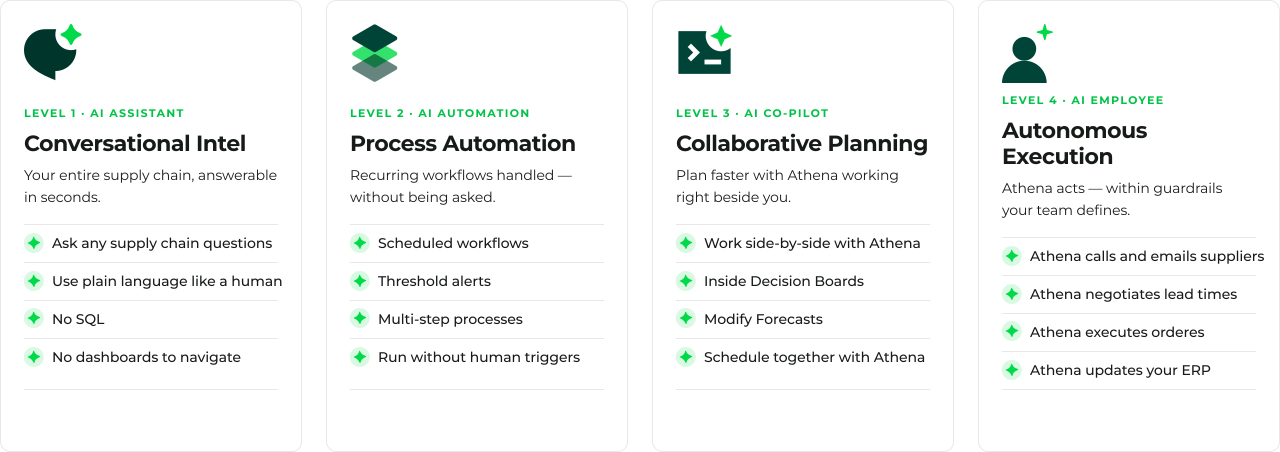
Athena's Four Levels of Agentic Intelligence
Athena is not a single tool — it is a spectrum. Depending on what a user needs and how much autonomy they want to delegate, Athena operates across four distinct modes. Each builds on the last, expanding from reactive assistance toward fully autonomous action. All four run simultaneously on the same platform, and every interaction in one mode generates signal and context that improves the others.
Level 1 — AI Assistant
Human-directed · Instant response
Ask Athena anything about your supply chain and get an answer in seconds — grounded entirely in your operational data, with no dashboard navigation and no query writing. Every response traces directly back to the data that produced it, so planners and analysts can trust what they're reading and act on it immediately.
Autonomy: Low — Athena responds, human decides
"Show me all SKUs with less than 10 days of coverage in the Northeast, sorted by revenue impact."
Level 2 — AI Automation
AI-orchestrated · Scheduled and event-triggered
At Level 2, Athena monitors your supply chain continuously — detecting threshold breaches, converting signals into structured issue lists, routing them to the right people by business rules, and triggering downstream actions automatically. Reports run themselves. Alerts fire the moment conditions are met. Every automation captures its outcomes as feedback data, feeding the learning loop. This replaces the patchwork of manual exports, spreadsheet macros, and brittle rule-based systems most supply chain teams depend on.
Autonomy: High — Athena executes on schedule, human reviews outputs
"Every Friday at 4pm, generate a supply risk summary, flag POs more than 5 days overdue, and send each commodity manager only their relevant items."
Guardrail: Outcomes are logged. Escalation thresholds and distribution lists are administrator-controlled.
Level 3 — AI Co-Pilot
Human + AI · Active planning sessions
At Level 3, Athena works alongside your planners in real time. During active planning sessions — demand reviews, S&OP cycles, supply analysis — Athena constructs Decision Boards, generates narrative insights grounded in actuals, customizes views, and surfaces recommendations inline as the work happens. The planner stays in control. Athena handles the analytical workload. The intelligence loop begins here: Athena tracks which analyses lead to which decisions.
Autonomy: Medium — Athena acts on instruction, human approves
"Add a 13-week rolling average, highlight weeks where actuals exceed forecast by 15%, and schedule this board to the S&OP team every Monday at 7am."
Level 4 — AI Employee
AI-autonomous · Always-on, within configured guardrails
At Level 4, Athena does not wait for a human to start a workflow — it runs one. Shortages are detected, suppliers are contacted, delivery commitments are negotiated, ERPs are updated, and executive briefings are distributed, all before your team sits down for the morning standup. Crucially, "fully autonomous" does not mean "unchecked" — every autonomous action operates within an enterprise-configured guardrail framework, with full traceability for what was detected, what was decided, what was executed, and what the outcome was.
Autonomy: Full — within configured guardrails
"Athena identifies a critical component with 3 days of coverage, calls the approved supplier, confirms expedited delivery within the authorized order window, updates SAP, and emails the VP of Supply Chain — before the morning stand-up."
Guardrail: Supplier outreach requires a pre-approved contact list. ERP writes require role authorization. All actions are logged with a full audit trail. Any action can be paused or reversed by an authorized user.
Controlled Autonomy — Built for Enterprise Trust
Autonomous AI in enterprise operations raises legitimate questions: What if Athena contacts the wrong supplier? What if it commits to a purchase that exceeds budget authority? What if something goes wrong at 2am and no one is watching?
The principle: autonomy is always delegated, never assumed. Every autonomous capability in Athena is off by default. Administrators configure what Athena is permitted to do, for which users, under which conditions, and up to which thresholds. Athena acts with authority that has been explicitly granted — not inferred.
| Guardrail | What it means in practice |
|---|---|
| Approval Workflows | Any autonomous action above a defined threshold (order value, supplier tier, coverage risk level) requires human sign-off before execution. Athena proposes, humans authorize. |
| Role-Based Autonomy | Administrators define which actions each user role can delegate to Athena. A planner may allow automated alerts; only a director can enable supplier outreach. |
| Audit Trails | Every action Athena takes is logged with full context: what was detected, what was decided, what was executed, and what the outcome was. Fully traceable for compliance. |
| Guardrail Rules | Hard limits on actions: maximum PO value without approval, blocked supplier contact lists, mandatory escalation thresholds. Configured by the enterprise. |
| Explainability | Athena does not just act — it explains. Every recommendation and action includes the reasoning and the data that drove it. No black-box decisions. |
| Human Override | Any in-progress automation can be paused, modified, or reversed by an authorized user at any point. |
The result is not "AI that runs wild" — it is a supply chain team with a highly capable new member whose responsibilities, authority limits, and accountability are as clearly defined as any human hire.
How ConverSight is Different
Compared to BI platforms
Platforms like Tableau, Power BI, Qlik, DataSelf, and Velixo are built to surface information, not act on it. They have no native planning layer, no agentic runtime, and no path from insight to execution. Adding a natural-language query interface to a BI tool — a common recent pattern — produces a conversational capability at best, without the supply chain semantic model required to make that capability operationally reliable. ConverSight includes full BI functionality as one component of a platform that also plans, executes, and learns, so insight and action live in the same system.
Compared to supply chain planning platforms
Planning-focused tools like NetStock, Blue Yonder, o9, and Kinaxis are strong within their specific domains. The limitation is that domain depth does not extend across the full operational picture. Connecting a planning tool to a BI layer, an AI layer, and an execution environment requires integration work that reintroduces exactly the semantic inconsistency and governance fragmentation a unified platform eliminates. ConverSight treats planning as one domain within a platform designed for cross-domain agentic decision-making — demand, supply, procurement, and execution sharing one model, one agent, one audit trail.
Compared to generic AI tools
Microsoft Copilot and generic LLM-based tools are horizontal products not built for operational supply chain. They are not trained on supply chain data, do not maintain governed connections to ERP systems, and cannot execute autonomous actions with domain-specific controls. They offer conversational response without the grounding required to make those responses operationally reliable — they cannot write back to an ERP, initiate supplier outreach, or produce decisions with a traceable audit trail. Athena is purpose-built: governed semantic layer, native ERP connectivity, and four levels of agentic capability designed for supply chain operations.
Purpose-Built for Supply Chain
ConverSight is built specifically for supply chain. Its AI agents operate on supply chain data models and purpose-built workflows. Its applications cover demand forecasting, supply planning, inventory optimization, supply assurance, and order management as native capabilities. Its agentic layer connects directly to ERP and MRP systems — including SAP, Oracle, Microsoft Dynamics, Acumatica, NetSuite, and SAGE — extending those systems with decision intelligence without replacing them.
Demand forecasting, supply planning, inventory optimization, supplier coordination, and order management each require purpose-built logic that general analytics platforms do not natively provide. Horizontal BI tools cannot fill that gap by adding a chat layer. Generic agent frameworks cannot fill it without months of custom development. ConverSight ships with the domain logic, the data connectors, and the agentic runtime already in place.
The Bottom Line
Every AI vendor claims agents. Not every AI vendor closes the loop. And not every platform is ready to run real workloads on day 1.
ConverSight is the Decision Intelligence Platform: built with an Agent-First architecture, specialized for supply chain, extending naturally into manufacturing, logistics, finance, and marketing. Athena, the AI at its core, is not a chatbot with operational data bolted on, not a BI dashboard with a language model in front of it, and not a generic agent framework that requires months of custom development. It is a governed, production-ready system that detects signals, makes decisions, takes actions, captures feedback, and learns — continuously, within enterprise-grade guardrails.
The organizations that win in supply chain will be the ones that close the loop fastest. Connect your data and start closing it today.